Should I buy a home on the North Shore now or wait for mortgage rates to drop?
If you've found the right home and the monthly payment works at today's rate, buying now can make sense if the home fits your needs, the full cost fits your budget, and your finances support the purchase. Waiting can also be reasonable. Compare both options using your actual costs and timeline. Freddie Mac's 30-year fixed average was 7.40% as of October 8, 2026, and nobody can tell you with certainty where it goes next. You can refinance if rates fall, but you can't go back and buy a home someone else bought while you waited.
By Laurie Field | October 12, 2026
Rates moved again last week, which caused me to hear from a few buyers I'm working with. The question I'm hearing from them in Highland Park, Deerfield, Northbrook, and Glenview is the same one: "Should we buy now, or wait until rates come down?"
It's a fair question and here's how I walk my buyers through it.
Where rates stand right now
These numbers come straight from Freddie Mac's weekly Primary Mortgage Market Survey:
- 30-year fixed: 7.40% as of October 8, 2026, up from 7.28% the week before
- A year ago: 6.30%
- 15-year fixed: 6.73%, up from 6.60% the week before
- In 2026 so far: a low of 5.98% and a high of 7.40%, so this week's rate is the top of that range
Two things to know about that number. First, it's a national average for buyers putting 20% down with excellent credit. Your rate will depend on your credit, down payment, loan size, and lender. Second, it changes every Thursday. Freddie Mac's next update comes out October 15, so check the current figure when you read this.
The Federal Reserve meets next on October 27 and 28. The Fed doesn't set mortgage rates directly, but its decisions and its tone move the bond market, and mortgage rates tend to follow. That makes the next few weeks hard to call in either direction.
Why "waiting for rates to drop" is a guess
I understand the instinct. Nobody wants to lock in at the high point. But waiting for lower rates involves several uncertainties and might pay off if:
- Rates actually fall, and by enough to matter.
- Prices don't rise enough to cancel out the savings.
- The right home is still there when you're ready.
You can't control any of those. So here's a quick example of how the math can work against you.
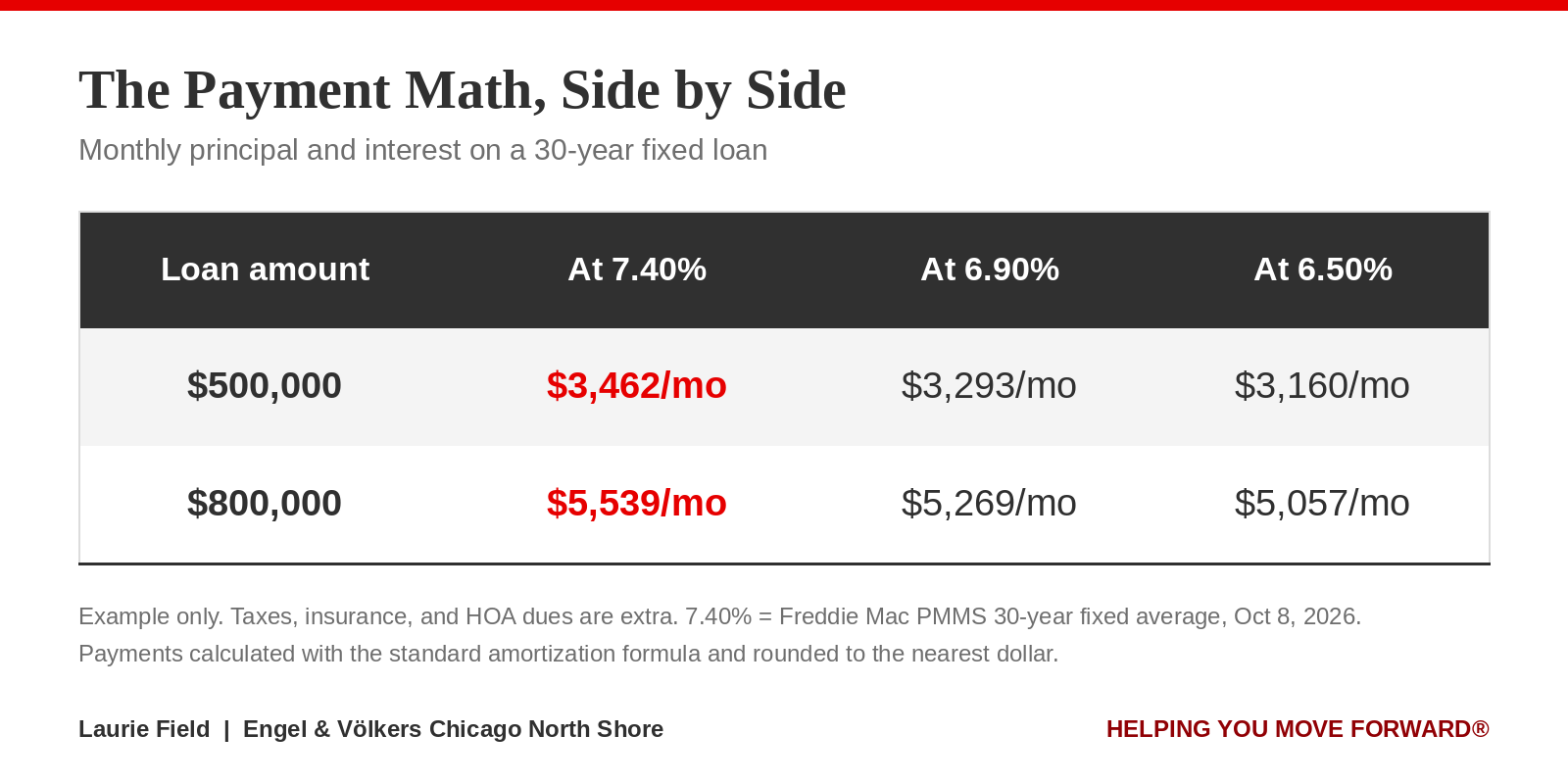
On the North Shore and in the Northern Suburbs of Chicago, taxes are a big part of the monthly number. On an $800,000 loan, a half-point drop saves about $270 a month. That's real money.
Now flip it around. At 6.90%, the same $5,539 monthly payment carries a loan of about $841,000. Put another way, if you wait for that half-point drop and the price of the home you want rises about 5% in the meantime (from $1,000,000 to roughly $1,051,000 with 20% down), your payment ends up right back where it started. That 5% is a hypothetical to show the trade-off, not a forecast.
And that's assuming rates drop at all. They went from 6.30% to 7.40% over the past year.
Your local number matters here. In Highland Park in September 2026, there were 2.2 months of inventory, and homes went from list to contract in a median of 16 days. When inventory is that tight, the home you're waiting on may not wait for you.
Buy the home, date the rate
You've probably heard this silly phrase. It's a little glib, but the idea underneath it is sound.
If rates fall meaningfully after you buy, you can refinance. But note that refinancing has closing costs, and you need to qualify again. So never buy a home you can only afford if you refinance. Buy one you can carry comfortably at today's rate, and treat a future refinance as a bonus.
Here are the main questions I ask concerned buyers:
- Can you carry the full payment at 7.40%, including taxes, insurance, and HOA dues (if there are any), without stretching?
- Do you plan to stay at least five to seven years? Longer ownership gives you more time to ride out rate swings.
- Does this home fit your life, or are you settling just to get in?
- Do you have an emergency fund that will remain intact after closing?
If you can check off all four, rates shouldn't be the thing stopping you.

Ways to soften a 7.4% rate
Today's rate isn't your only option. There some other options your lender can talk through with you. They include:
Seller credits. When a home has been on the market a while, or a seller is motivated, a credit at closing can cover closing costs or pay for a rate buy-down. Whether a seller will agree depends on the home, the price range, and how long it's been on the market.
Temporary buy-downs. A 2-1 buy-down temporarily subsidizes your payments to amounts calculated at a rate two percentage points below the note rate in year one and one percentage point below it in year two. Beginning in year three, you pay the full scheduled payment. On an $800,000 loan at 7.40%, that works out to roughly $19,000 in payment savings over two years (my math is for an example only). Someone pays for that up front, often the seller. It helps you through the first two years, but you still need to qualify for and be able to afford the full rate.
Permanent buy-downs (discount points). You pay points at closing for a lower rate for the life of the loan. Whether it's worth it depends on how long you'll keep the loan. Ask your lender for the break-even point.
Shop more than one lender. Freddie Mac's own chief economist, Sam Khater, said in the October 8 release that getting multiple quotes "can potentially save [a buyer] thousands over the loan's lifetime." Get at least two or three Loan Estimates and compare them line by line.
Know your loan size. The 2026 conforming loan limit is $832,750 for single family homes (including condos and townhouses) in most counties, according to FHFA. Loans above your county's limit are jumbo loans, and their rates and requirements can differ. Many North Shore purchases land near or above that line, so ask your lender where your loan falls.
Should you lock your rate before the Fed meeting?
Nobody can tell you where rates will go after October 28. What I can tell you is how to think about it.
If you're under contract or close to it, talk to your lender about lock periods and float-down options. A float-down lets you lock today and capture a lower rate if one appears before closing, usually for a fee. This is subject to the lender’s eligibility rules, deadlines, and required rate improvement. Lock terms vary by lender, so ask specifically what yours offers and what it costs.
What waiting actually costs
Waiting can be expensive, especially if you're renting. Every month you wait is a month of rent with no equity, and a month of watching inventory you may not see again.
Some buyers have good reasons to wait: a job change, a down payment that's still growing, or a family timeline that isn't set. Those are understandable reasons. "Rates might drop" by itself usually isn't.
For move-up buyers who already own, the calculation has one more layer: you're trading a lower rate on your current home for a higher one on your next. Your equity, how long you'll stay, and whether you can buy before you sell all factor in. If you can carry both payments for a period of time, you're in a strong position on the North Shore, and Northern Suburbs of Chicago because it takes away the biggest seller fear: "If I sell, where am I going to go?"
Frequently Asked Questions
Will North Shore home prices drop because mortgage rates are high?
Higher rates can slow price growth, but they don't automatically lower prices, especially where inventory is tight. On the North Shore and in the Northern Suburbs of Chicago, the answer varies by town and price range. Ask for the current months of supply and median sale price in the specific town you're considering, pulled from MLS data.
How much house can I afford at a 7.4% mortgage rate?
On a 30-year fixed loan, every $100,000 borrowed at 7.40% costs about $692 a month in principal and interest. Property taxes, insurance, and HOA dues come on top of that, and on the North Shore and in the Northern Suburbs of Chicago, taxes can add significantly. Get pre-approved with a lender so you're working with your actual number.
Should I wait for the Fed to cut rates before buying?
The Fed's next meeting is October 27 and 28, 2026, but Fed decisions don't move mortgage rates one-for-one. Waiting on a Fed move is a guess about timing, size, and how the bond market reacts. If the home and the payment both work today, buy on those terms.
Can I refinance if rates go down after I buy?
Yes, if you qualify and the savings outweigh the closing costs. Ask your lender how many months it would take for the monthly savings to cover the refinance costs. Buy a home you can afford at today's rate, and treat a refinance as an upside.
The bottom line
Rates at 7.40% are higher than any of us would like. But the best time to buy is when you've found the right home, the payment works, and you plan to stay. Rates will move. The right home in the right North Shore or North Suburban town might not come back.
If you're weighing this decision for your own situation, I'm happy to walk through the numbers with you, side by side, for the towns and price ranges you're considering. Call or text me at 312-504-7010, or email [email protected].
HELPING YOU MOVE FORWARD®
About Laurie Field
Laurie Field is a Real Estate Advisor with Engel & Völkers Chicago North Shore, serving Highland Park, Deerfield, Northbrook, Glenview, Glencoe, Winnetka, Wilmette, Lake Forest, and Chicago. A lifelong Highland Park resident and University of Michigan graduate, Laurie has more than 10 years of experience, 76 closed sales, and almost $60,000,000 in career sales volume, including a career-high sale of almost $4,000,000. She is a five-time recipient of the Engel & Völkers Ruby Elite Award (2025, 2024, 2023, 2021, 2020), received the Onyx Elite Award in 2022, and has earned Pillar Awards for Culture of Leadership (2025), Bespoke Experiences (2024 and 2022), and Reclaiming Luxury (2023). Clients describe her as knowledgeable, responsive, and calm, an advocate who gives honest advice and helps first-time buyers, move-up buyers, luxury buyers, and downsizers make confident moves.
---
*Sources: Freddie Mac Primary Mortgage Market Survey, October 8, 2026 (freddiemac.com/pmms); Federal Reserve FOMC meeting calendar (federalreserve.gov); FHFA 2026 conforming loan limit announcement (fhfa.gov). Payment examples are the author's calculations and are for illustration only.
This post is not financial or lending advice; consult a licensed mortgage professional about your situation.
Categories
Recent Posts