Should I List My North Shore Home Now or Wait Until Spring?
Should I List My North Shore Home Now or Wait Until Spring?
It's the strategic question I'm hearing most from sellers right now. The answer isn't what most people expect.
Spring brings as many as 30-40% more buyers in Chicagoland markets. That's the headline everyone knows. But here's what sellers often miss: spring also brings significantly more competition among sellers. Your home doesn't just need to attract buyers, it needs to stand out against all of the other sellers in your price range and neighborhood.
February and early March present a different dynamic. Fewer buyers, yes. But also fewer options for those buyers to compare. And the buyers active in February are serious. They're not casually browsing. They need to move.
The right timing depends on three factors: your home's condition, your timeline, and your goals. Here's how to evaluate which approach serves you better.

What Does Spring Market Activity Actually Look Like on the North Shore?
Spring has earned its reputation as the peak selling season for good reason. Buyer activity historically increases 30-40% between March and June compared to winter months across Chicagoland markets.
This surge is predictable. Families want to close before the school year starts. Weather improves, making homes show better. Buyers who paused their search in December and January return with renewed urgency.
But increased buyer activity tells only half the story.
Inventory rises even more dramatically. When your home hits the market alongside a dozen others in your neighborhood, buyer attention fragments. Each property competes not just on merit but on positioning, pricing precision, and marketing execution.
I've watched well-prepared homes sell quickly in April. I've also watched overpriced or poorly staged homes sit for months despite strong spring traffic. The season creates opportunity, but it doesn't guarantee results.
The spring advantage: More potential buyers see your home. More showings. Higher likelihood of multiple offers if your home is priced right and shows exceptionally well.
The spring challenge: Your home needs to win against more competition. Pricing becomes less forgiving. Days on market stretch longer if you're not positioned perfectly from day one.
When Listing Now Makes Strategic Sense
February and early March listings operate under different rules. Consider listing now if your situation aligns with these scenarios:
Your Home Is Move-In Ready
Winter buyers have high standards and limited patience. They're comparing fewer properties, which means they scrutinize each one more carefully. If your home is immaculate, professionally staged, and requires no deferred maintenance, you can command attention that would be diluted in a spring flood of listings.
Move-in ready means: fresh paint, updated fixtures, modern finishes, clean landscaping despite the season, professional photography that captures your home at its best. Winter listings cannot hide flaws. But exceptional winter listings stand out dramatically.

You Need to Sell Before Buying
Contingent offers are significantly easier to negotiate when competition is lower. In spring markets, multiple-offer situations often require non-contingent offers to compete. If you need to sell your current home to buy your next one, February gives you leverage that April typically doesn't.
Your Timeline Requires It
Job relocations, family changes, financial deadlines, and life transitions don't align with ideal market timing. If you need to close by May, waiting for April may not serve you.
A February listing gives you more time to market, negotiate, and close before an April or May listing. Waiting until April compresses your timeline and may force compromises that cost more than any potential spring premium.
You Have a Unique or Luxury Property
Premium properties, architecturally distinctive homes, and luxury listings often perform consistently across seasons because their buyer pool is smaller and more targeted. These buyers search year-round, not seasonally.
The Competitive Landscape Favors You
Check current inventory in your price range and neighborhood. If there are hypothetically currently only 3 comparable homes listed in Highland Park between $800K-$1.2M, you face minimal competition. That changes when spring arrives and 20-30% listings hit the market simultaneously.
Less competition means more buyer attention on your listing. It means your home isn't the seventh option buyers see that weekend. It means negotiations happen faster with fewer alternatives driving buyer leverage.

When Waiting for Spring Makes Sense
Hold off until spring if these factors describe your situation:
Your Home Needs Preparation Work
If you're planning updates, staging improvements, curb appeal projects, or repairs, complete them before listing. A mediocre February listing won't improve by sitting on the market through March. A well executed April listing will outperform a rushed February one.
Strategic updates that justify waiting:
- Kitchen or bathroom modernization that affects buyer perception
- Interior painting, flooring replacement, or fixture updates
- Landscaping and curb appeal projects (easier to execute in spring anyway)
- Staging consultation and implementation
The market rewards readiness, not speed. Launch when your home can compete at the highest level.
Your Home Needs Seasonal Staging Advantages
Some properties simply show better in spring. Homes with exceptional outdoor spaces, gardens, pool areas, or lake views benefit from seasonal staging that February can't provide. If your home's best features are weather-dependent, waiting makes strategic sense.
What Actually Drives Your Sale Price (It's Not Just the Season)
After 10 years and over 90 transactions on the North Shore, I've learned that execution matters more than market timing.
Homes sell above asking in February when positioned correctly. Homes sit on the market all spring when fundamentals are wrong.
What actually drives results:
Pricing Accuracy
Your sale price is determined by recent comparable sales, not by what you hope to achieve or what your neighbor listed for last summer. I pull sales from the past 60-90 days in your specific neighborhood. Highland Park pricing patterns differ from Glencoe, which differ from Winnetka and Lake Forest.
Overpricing costs you time and money regardless of season. Underpricing leaves money on the table. Accurate pricing creates urgency and competitive tension.
Home Condition and Presentation
Professional photography, strategic staging, and immaculate condition aren't optional in today's market. Buyers form opinions within seconds of seeing listing photos online. If your home doesn't photograph exceptionally well, 70-80% of potential buyers will never schedule a showing.
Strategic preparation includes:
- Decluttering and depersonalizing every room
- Professional staging (at minimum, consultation)
- High-end photography including drone and twilight shots
- Minor repairs and cosmetic updates that remove buyer objections
- Deep cleaning that exceeds typical standards
Negotiation Strategy
Strong negotiation begins before the first offer arrives. It includes positioning your home correctly, creating urgency through strategic pricing, and managing the offer process to maximize both price and terms.
I've negotiated close to 100 transactions. Every situation is different. Some sellers prioritize price. Others need timeline certainty or specific contingencies. Skilled negotiation delivers the outcome that serves YOUR goals, not just the highest number.
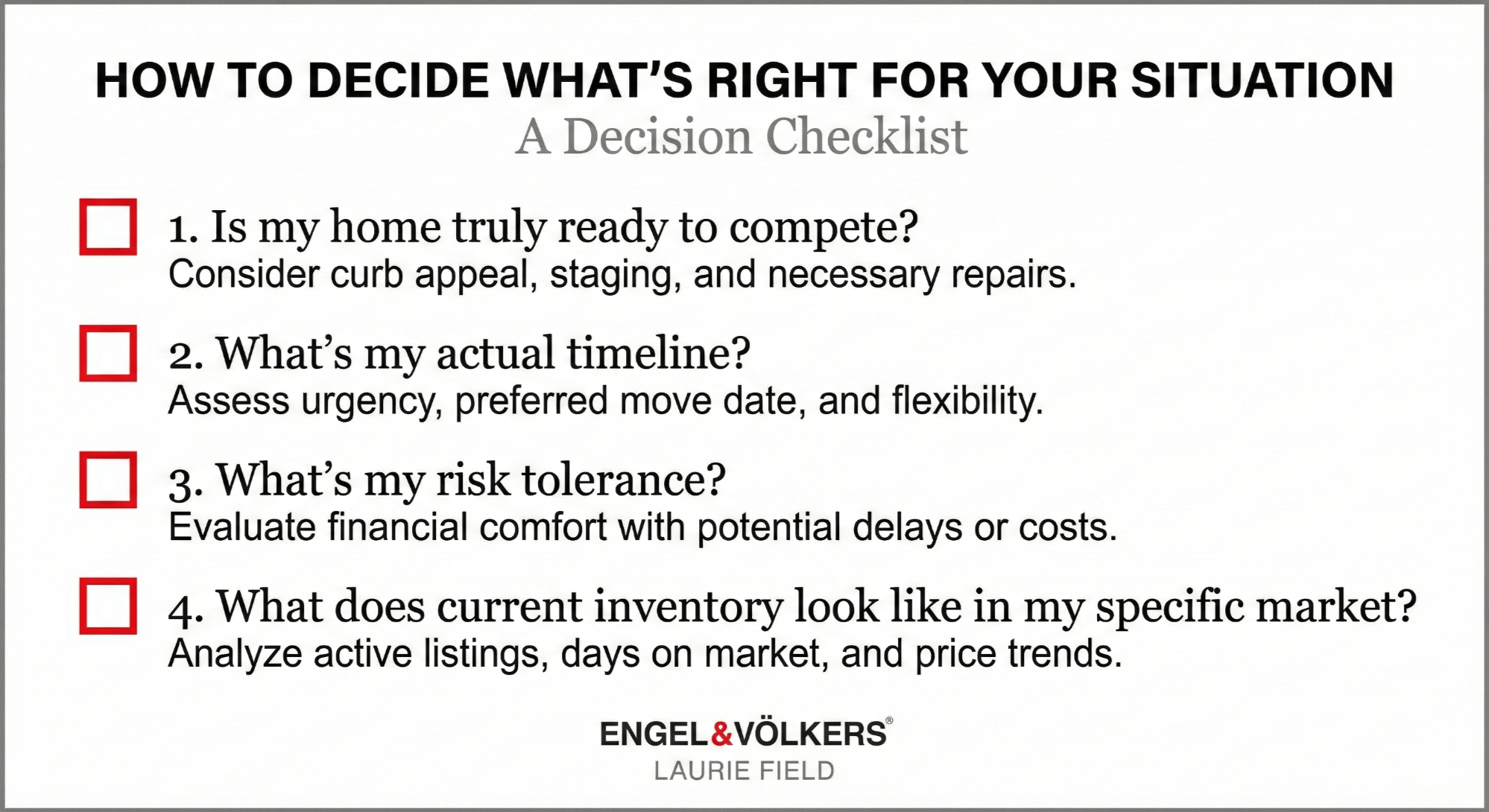
How to Decide What's Right for Your Situation
Ask yourself these questions:
- Is my home truly ready to compete?
- Would I buy it at the price I want to list it for?
- Does it show better than comparable homes currently on the market?
- Is it clean, decluttered, and move-in ready?
If you answered no to any of these, you have work to do before listing. Whether that happens in February or April depends on your timeline and how quickly you can execute improvements.
- What's my actual timeline?
- Do I need to close by a specific date?
- Am I selling before buying, or do I have flexibility?
- How much time pressure am I really under?
Your timeline often determines your strategy more than market conditions do.
- What's my risk tolerance?
- Am I willing to test a higher price and adjust if needed?
- Do I need certainty and a faster process with less competition?
- Can I afford to wait if spring doesn't deliver the results I expect?
There's no wrong answer, but you need to know your priorities before making strategic decisions.
- What does current inventory look like in my specific market? This requires real data, not assumptions. Check:
- How many homes are currently listed in your price range and neighborhood?
- How many sold in the past 90 days?
- What were the average days on market and list-to-sale price ratios?
- What's projected to hit the market in the next 60 days?
The Bottom Line
The best time to sell your North Shore home is when your goals, your home's readiness, and market conditions align. For some sellers, that's now. For others, it's spring.
Spring isn't automatically better. February isn't automatically worse. What matters is strategic positioning based on your specific situation.
If you're navigating this decision, let's have an honest conversation. I'll pull current data for your neighborhood, review recent comparable sales, and give you a straightforward assessment of what listing now versus spring would mean for your property.
No pressure. No generic advice. Just honest analysis based on 10 years of North Shore market experience and 90+ transactions serving Highland Park, Deerfield, Glencoe, Lake Forest, Winnetka, Wilmette, Northbrook, and Glenview.
The North Shore market rewards preparation and strategy, regardless of season.
HELPING YOU MOVE FORWARD®
Categories
Recent Posts